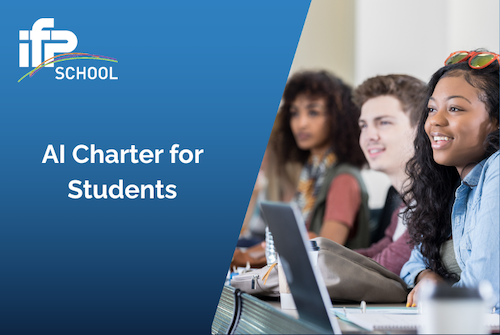
Since September 1st, IFP School has adopted a new charter on the use of generative artificial intelligence (AI), intended for students, teaching staff, and School personnel.
Pascal Longuemare, Dean of IFP School, presented the initiative during the welcome event for the Class of 2027.
“We believe that AI must be a tool that serves learning, research, and innovation. But it must under no circumstances replace critical thinking,” he emphasized.
Incorporated into the School’s internal regulations, this charter is now signed by every student at the start of their studies.
With this initiative, IFP School reaffirms its commitment to promoting the ethical and respectful use of AI at the heart of its training programs and its community.
Origins of the Initiative
For several years, the Lab e·nov™, IFP School’s educational innovation laboratory, has been carrying out various initiatives related to artificial intelligence: testing tools, introductory AI training designed for staff, courses and hands-on workshops for students, etc.
In early 2026, IFP School contributed to the work of the AI working group of the RESDD (Network of Higher Education Institutions for Sustainable Development), which resulted in a roadmap, an operational toolkit, and 13 practical guides.
Following on from this work, the Lab e·nov™ team organized a workshop last June dedicated to defining an AI strategy with the teaching staff, program supervisors, and directors of IFP School’s training centers.
These discussions identified four priority projects, on which the School mobilized teams between June and August: the deployment of a chatbot integrated into the School’s Learning Management System (LMS), the development of a second chatbot for one of the training programs and the drafting of the charter on the use of generative AI.
At the end of August, João Silveira, Head of Steering and Overall Strategy, Lab e·nov™, and Jérémy Demolliens, Head of the Immersive Realities Hub, presented the draft charter to IFP School’s Executive Committee (CODIR), with the participation of Christophe Corlay, IT and Logistics Manager, and Arnaud Torres, Associate Professor at the Georesources and Energy Center.
The members of the CODIR then reviewed the charter, provided their recommendations, and approved the establishment of an AI governance body. Its mission is now to oversee the training of students and teaching staff with regard to AI, promote the relevant use of these technologies, and rethink assessment methods.
Then, during the School’s summer seminar, all School staff were invited to contribute to a final review of the texts.
Key Principles and Best Practices to adopt
The new charter provides a common framework to encourage use that is relevant, well-managed, and aligned with the School’s values.
“Its fundamental principle is humanization,” notes Jérémy Demolliens.
“With this charter, we encourage users not to delegate their judgment to machines, and to preserve their critical thinking. AI demands rigor and discernment!” he insists.
A distinctive feature of the charter is that it fits on a single page, making it easier to read and apply.
For the School’s students, the charter points out that generative AI can be used as a learning support tool: exploring topics, generating ideas, enriching, translating or rephrasing existing work, coding assistance, data analysis, and exam preparation.
However, it emphasizes one core principle: AI must support students’ thinking, never replace it. Students therefore remain responsible for any content produced with its help and must be able to explain, justify, and defend it.
When students use AI in submitted work, they must state this explicitly, specifying how, why, and for what purpose the tool was used. The charter also prohibits the use of AI during exams without explicit authorization, as well as any breach of the rules on confidentiality, data protection, and intellectual property.
A specific version of the charter is also intended for School staff, to provide a framework for the use of generative AI in teaching, administrative, and research activities.
It invites everyone to disclose any use of AI in their professional documents, to check and question the results produced, to remain vigilant about hallucinations and algorithmic bias, and to comply with the European legal framework (AI Act) and data protection rules (GDPR).
The charter also stresses the need to reserve the use of AI for tasks with real added value, taking its environmental impact into account, and points out that decisions affecting people, assessment, support, recruitment, or human resources, must remain a human responsibility.
In this respect, staff have a role to play in setting an example: students also learn by observing the rigor, discernment, and critical thinking with which IFP School’s educational community uses these tools.
This charter marks an important step in IFP School’s collective adoption of generative AI. It reflects the School’s determination to support ongoing transformations with high standards and responsibility, while placing human thinking at the heart of learning, teaching practices, and the life of the institution.
Article written by Meyling Siu