
Since September 1st, IFP School has had a new electrical engineering laboratory.
Alessio Dulbecco, Supervisor of the Powertrain Engineering program, introduces this new space dedicated to experimentation on electric machines and power converters.

1. Where is the new laboratory located?
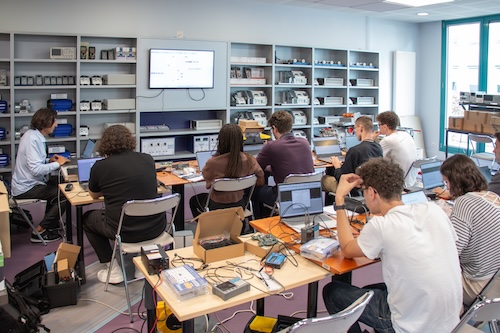
The new electrical engineering laboratory is located on the ground floor of IFP School, in a bright space with large windows, designed to offer students a working environment that is both functional and pleasant.
2. Where did the idea come from, and how long has this project been in preparation?
The idea arose two years ago from the redesign of the Powertrain Engineering specialized engineering program. The program was rethought around learning-by-doing, giving a much greater role to practical activities. It therefore became essential to have a suitable laboratory where students could experiment and work in good conditions.
3. What educational need does it meet? What types of work and/or study projects can students carry out?
The laboratory makes it possible to work on the characterization and control of electric machines and power converters, as well as on the design and testing of electronic circuits, particularly those related to the powertrain of an electric vehicle.
It is mainly used by the Powertrain Engineering program, but will also be able to host activities from the Energy and Powertrains and Offshore Wind Project Development programs. The aim is to develop practical skills in electrical engineering, power electronics, control, measurement, and experimentation.
4. What concrete difference will this laboratory make for students in the way they learn or prepare for industry expectations?
At a time when artificial intelligence is transforming the engineering professions, we believe it is essential to maintain a strong connection with the physical reality of systems. Designing a device, building it, testing it, and measuring its performance leads to a better understanding of real-world phenomena and constraints.
Students who adopt this approach and working method will thus have directly applicable skills and will be able to become operational quickly in a company.
5. What test and measurement equipment does the laboratory have?
The laboratory is equipped notably with test benches for characterizing the main types of electric motors, as well as power converters and their control systems.
Another important added value is that students can design, build, and test basic electronic circuits themselves, directly comparing theory with experimentation.
6. How does this laboratory address the current challenges of the energy transition, electrification, and the evolving professions for which IFP School prepares its students?
Electrification is now one of the main levers for decarbonizing mobility. It of course concerns battery electric vehicles, but also the various hybrid architectures, fuel cell vehicles and, more broadly, all energy systems incorporating electric machines, power electronics, and energy storage devices.
The new electrical engineering laboratory enables students to go beyond a purely theoretical approach and gain a concrete understanding of how these systems work. In particular, they can study the principles of electromechanical energy conversion, characterize different electric machines, analyze their torque, power, efficiency, and losses, and observe the influence of operating conditions and control strategies.
The laboratory also makes it possible to address power electronics, which plays a central role in electrified drivetrains. Students can understand how converters, inverters, and their control laws work, and also analyze transient phenomena, conduction and switching losses, and the associated thermal constraints.
One of the major educational challenges is learning to reason at the level of the complete system. It is not enough to optimize a battery, an inverter, or an electric machine separately: students need to understand their interactions, operating ranges, and limitations, as well as the impact of architecture and control choices on overall performance.
Students also learn to compare the models used in simulation with measurements taken on real equipment. This interplay between modeling, control engineering, instrumentation, and experimentation is essential in today’s engineering professions. It helps develop genuine critical analysis skills: understanding a model’s assumptions, interpreting an experimental result, identifying measurement uncertainties, and explaining the differences between the theoretical behavior and the actual operation of a system.
Finally, this laboratory directly supports the evolution of the professions for which IFP School prepares its students. Companies are now looking for engineers able to work at the interface between electrical engineering, power electronics, automatic control, thermal engineering, mechanics, and embedded systems. The laboratory therefore helps train profiles capable of designing, modeling, testing, controlling, and optimizing the electrified drivetrains of the future, as well as stationary energy conversion and management systems.
7. Who was involved in its design?
The project stems from the educational thinking around the evolution of the Powertrain Engineering program, but its implementation was a genuinely collective effort.
The involvement of IFP School’s administration and training centers, IFP Training, and IFPEN’s technical and safety teams was crucial. Their commitment and coordination made it possible to fit out, equip, and make the laboratory operational on schedule.
Interview conducted by Meyling Siu