
For the first time, we have chosen to highlight in this newsletter a scientific article based on the work of researchers at IFP Energies nouvelles who also teach at the School. Maria-Fernanda Romero Sarmiento and Sébastien Rohais are both accredited to supervise research; Sébastien is also a graduate of the Geology program, IFP School Class of 2003. This is a concrete way of showing how research conducted at IFPEN feeds into the School’s teaching and helps bring new course topics to the fore. The article focuses on the characterization of microplastics.
Although this topic is not yet directly covered in the Processes and Polymers (POLY) program, “it fully echoes the issue of the environmental impact of plastics, notably through the Plastic Environmental Impact course, as well as the courses devoted to regulatory issues and circularity,” points out Vanessa Chávez Bracho (POLY Class of 2014), Supervisor of the POLY program.
Are you interested in this kind of bridge between research and teaching? Would you like to see more work by IFPEN researchers featured in our upcoming newsletters? Write to us at: alumni-ifpschool@ifpen.fr
Introduction by Sabine Lalanne
A multivariate index to estimate the degradation age of plastics in the oceans
Estimating the residence time of plastics in marine environments is a major challenge for understanding their fate, assessing pollution flows, and improving ocean dispersion models. Until now, plastic aging has generally been assessed on the basis of a single physicochemical indicator, whereas polymer degradation results from complex processes simultaneously influenced by: photo-oxidation, mechanical abrasion, biodegradation, the intrinsic properties of the polymers, and environmental conditions.
An Aging Index Based on Several Analytical Techniques
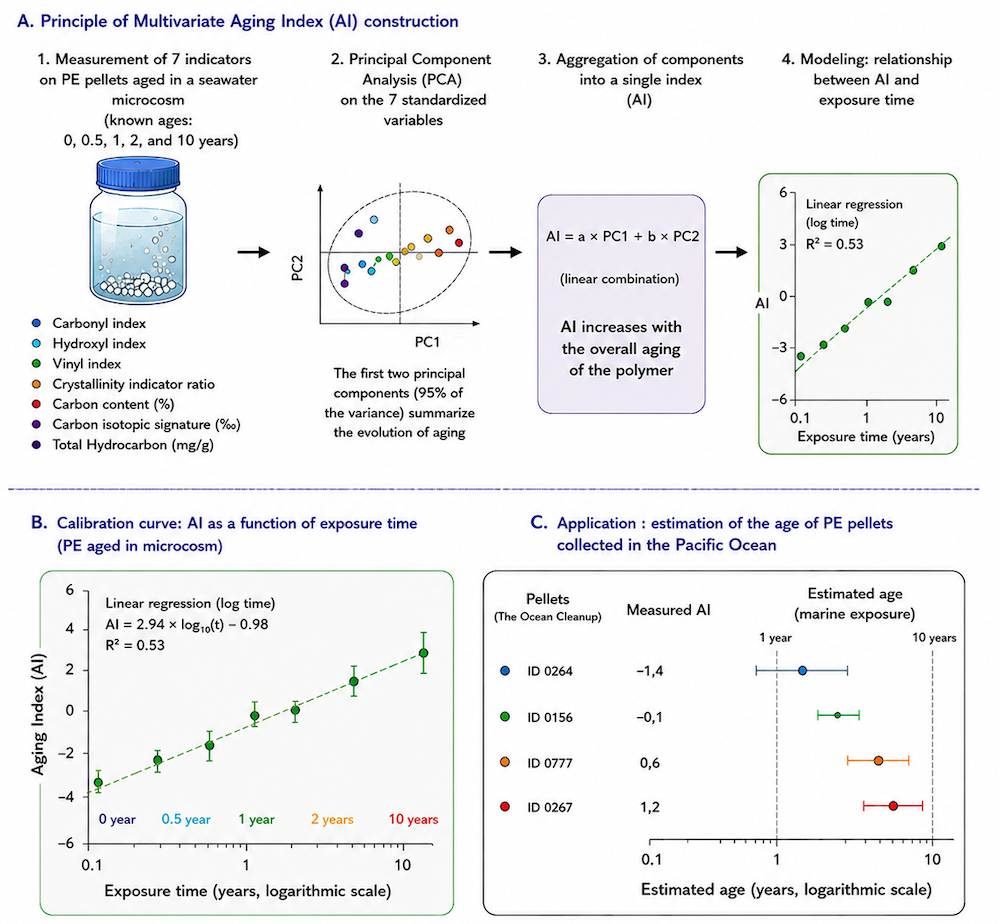
In this context, Baby et al. (2026) propose an innovative approach based on a multivariate aging index, called the Aging Index (AI), built using principal component analysis (PCA). The aim is to combine several degradation indicators in order to obtain a more robust estimate of the age of plastics exposed to the marine environment.
To develop this approach, several polymers - polyethylene (PE), polyethylene terephthalate (PET), and polylactic acid (PLA) - were aged in a seawater microcosm reproducing controlled marine conditions for periods ranging from a few months to ten years. The polymers were then characterized using several complementary analytical techniques: infrared spectroscopy (FTIR), Raman spectroscopy, elemental analysis coupled with isotope ratio mass spectrometry (EA-IRMS), and the Rock-Eval® thermal method, used here for the first time as a tool for characterizing polymer aging.
A Valuable Step Forward for the Traceability of Plastic Waste
The results show that each parameter evolves differently during aging. The FTIR indices reveal the formation of oxygenated functional groups linked to the oxidation of polyolefins, while crystallinity, isotopic composition (δ¹³C), and the parameters derived from Rock-Eval® sometimes show non-linear changes. These observations confirm that no single indicator on its own can accurately describe the degradation state of a plastic.
To overcome this limitation, seven analytical parameters, measured on polyethylene pellets aged in a microcosm, were selected. The principal components derived from the PCA, representing 95% of the data variance, are then aggregated into a single index, the Aging Index (AI). A regression relationship is then established between this index and exposure time, making it possible to estimate the degradation age of environmental samples.
The model was then applied to four polyethylene pellets collected in the Pacific Ocean by The Ocean Cleanup®, leading to an estimated marine exposure time of between 1 and 2.5 years.
The entire approach (method construction, calibration, and validation) is summarized in Figure 1.
This study represents a significant methodological advance based on a multivariate approach that has been shown to represent the complexity of plastic aging better than conventional indicators considered individually. In the longer term, the Aging Index could become a valuable tool for tracing plastic waste, reconstructing pollution scenarios, and validating models of microplastic transport in marine environments.
Reference:
Baby, M.G., Romero-Sarmiento, MF., Rohais, S. et al. A multivariate approach to estimate the degradation age of plastics in marine environments. npj | Material Degradation (2026).
>> DOI: https://doi.org/10.1038/s41529-026-00825-5
>> Cite as: https://www.nature.com/articles/s41529-026-00825-5#citeas
Scientific contacts: Maria-Fermanda Romero-Sarmiento, Sébastien Rohais
Source: IFP Energies nouvelles website