On November 20, IFP School welcomed twenty engineering students to its campus for a special half-day event dedicated to powertrains and sustainable mobility.
The goal of the event was to present the School’s three Specialized Engineering programs focused on mobility, giving students a clearer understanding of their content, specific features, and related career opportunities. It was also an opportunity to showcase the School’s innovation, expertise, and dynamism in the field of powertrains.
A dedicated time for discussion
The morning began with remarks from Claude Nuñez, Director of the Powertrains and Sustainable Mobility Center, who welcomed the participants and introduced the programs: the Energy and Powertrains program (MOT), the Powertrain Engineering program (PWT), and the Energy and Products program (PRO).
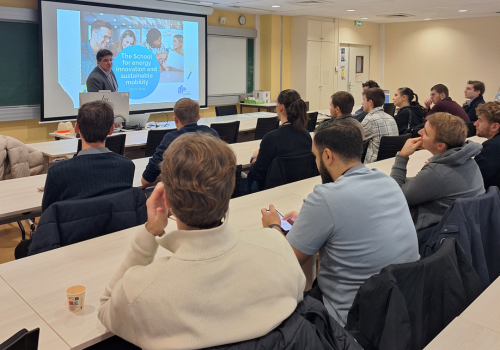
It was also an opportunity to highlight the new features introduced in these programs to better meet industry needs and the ongoing transformation of mobility, namely:
For MOT:
- A stronger focus on the electrification of powertrains, including hybrid systems and hydrogen-powered engines;
- Expanded hands-on project work on electric vehicles, hybrid systems, and demonstrators;
- Integration of modules on data, energy modeling, and applied artificial intelligence.
For PWT:
- A full focus on electric powertrains;
- A strong practical component, with 35–40% of the curriculum spent in the electrotechnics laboratory;
- A final-year project centered on complete demonstrators (electric scooter or kart) covering design, modeling, control, and integration.
For PRO:
- Updates centered on low-carbon fuels and products (biofuels, e-fuels, lubricants, and the production and distribution of multi-vector energies);
- Strengthened focus on maritime and aeronautical applications;
- Addition of modules on circular economy, supply chain, energy trading, and logistics;
- Increased hands-on training: lubricant formulation, engine test benches, and industrial site visits.
"These enhancements reaffirm our ambition: to train engineers capable of addressing the full spectrum of the energy transition—from electric propulsion systems to renewable fuels, including data analysis and digital technologies,” he explained.
Finally, Claude Nuñez highlighted the industrial and technological challenges these programs prepare students to meet, at a time when innovation, electrification and the energy transition are reshaping mobility. It was the perfect introduction to the various hands-on workshops awaiting the participants.
Immersive workshops to discover projects and facilities
Divided into small groups, the students took part in a series of workshops held both at the School and on the IFP Energies nouvelles site.
At the School, the groups were able to:
-
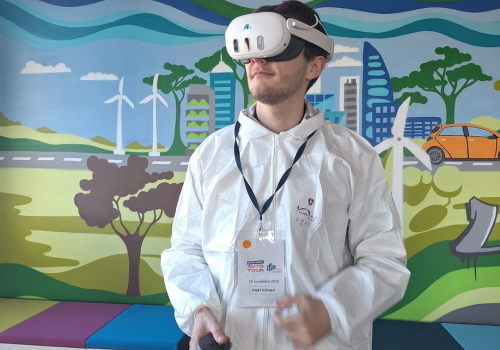
Test a virtual reality module on electric vehicles in the VR Lab;
-
Visit the engine exhibition hall;
-
Explore the student project centered on developing an electric scooter.
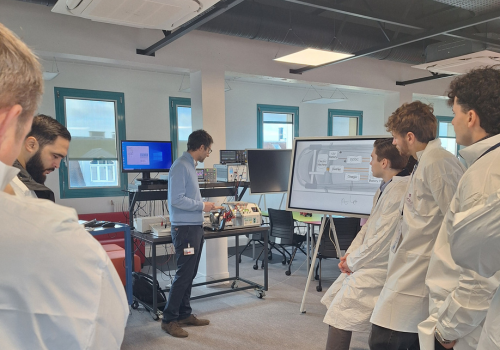
At IFP Energies nouvelles, the workshops allowed participants to:
-
Follow the transformation of a combustion-engine kart into a fully electric vehicle, a capstone project carried out by three students from the Energy and Powertrains (MOT) program, Class of 2025;
-
Meet Marc Guillemaud, an IFP School graduate (ENEP, 2012) and co-founder of the startup FacteurDix, who presented a two-seater, ultra-light, high-efficiency electric vehicle developed by his team;
-
Visit a system test bench.
An inspiring moment for future candidates
“The students’ energy, questions, and curiosity made this morning a rich and stimulating moment,” said Claude Nuñez at the close of the event.
This half-day session offered visitors a concrete insight into the projects, equipment, and career prospects available through the Specialized Engineering programs of the Powertrains and Sustainable Mobility Center, further strengthening the School’s appeal among talents interested in the mobility of tomorrow.
Our application campaign for the Specialized Engineering programs and the Advanced-Master degrees (Mastère Spécialisé®) is open until 15 April — visit our website for more information.
Article written by Meyling Siu